

7 Best Automated Data Lineage Tools in 2026
A modern data estate spreads across warehouses, lakes, streaming pipelines, transformation frameworks, and BI dashboards, and it changes every day. When someone renames a column, refactors a dbt model, or deprecates a source table, the question "what downstream of this breaks" has no answer a person can hold in their head. Automated data lineage tools answer it by continuously reading metadata, query logs, and transformation code to reconstruct the map of where data comes from, how it is transformed, and where it ends up. The shift from hand-drawn diagrams to automated discovery is now a baseline expectation: the data lineage automation segment is projected to grow from $1.66 billion in 2025 to $2.07 billion in 2026, a 24.4% annual rate, according to The Business Research Company's Data Lineage Automation Global Market Report 2026, as AI systems that need trustworthy data provenance and tightening regulation both raise the cost of not knowing where data comes from.
This guide covers what automated lineage tools do, the criteria we used to compare them, seven of the strongest options in 2026 with their real strengths and trade-offs, a side-by-side comparison table, and a framework for matching one to your estate.
What are automated data lineage tools?
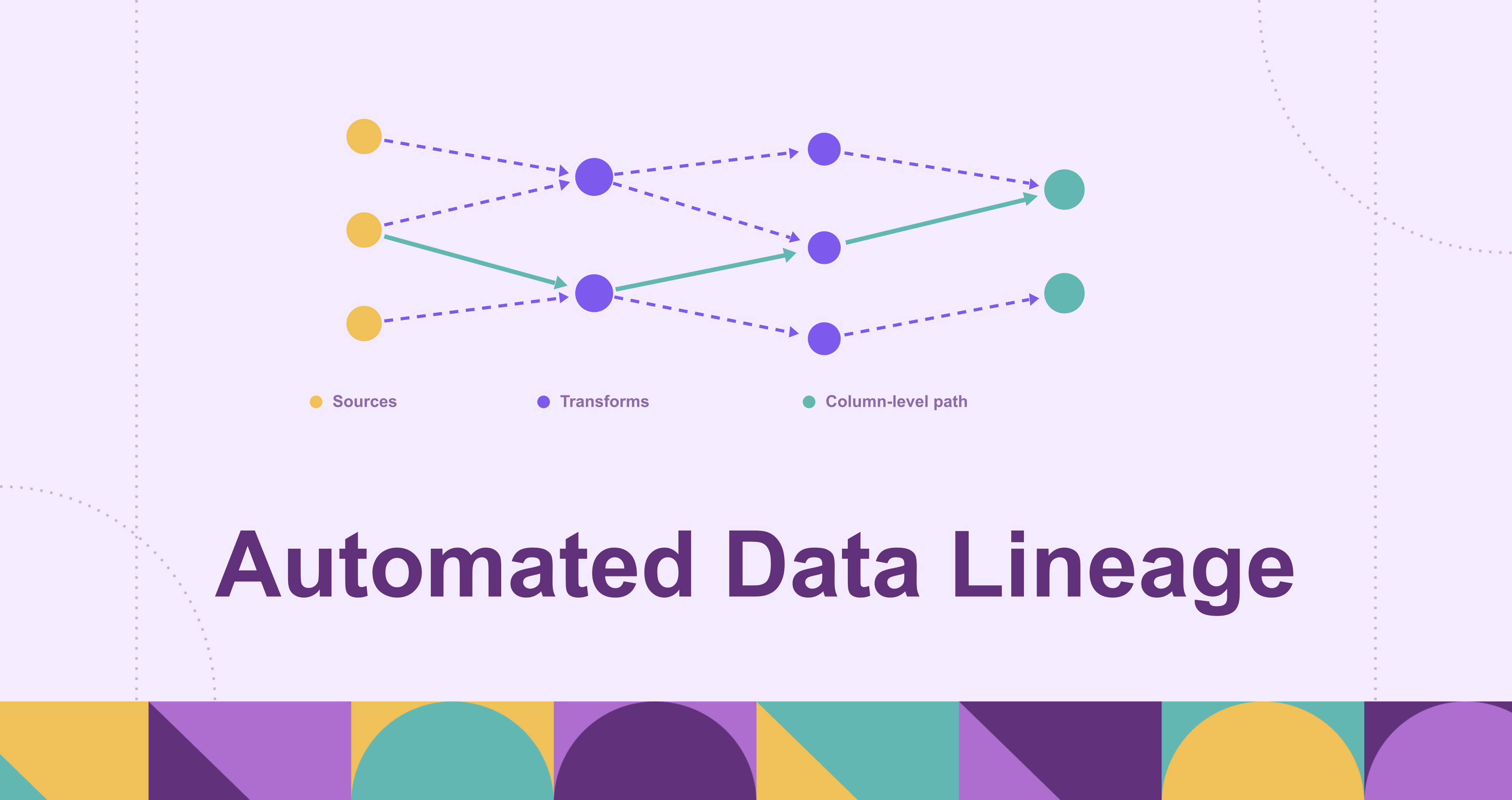
Automated data lineage tools discover and map how data moves through an organization without anyone drawing the map by hand. They connect to the systems in a data stack, sources, ingestion and ETL/ELT pipelines, the warehouse or lakehouse, transformation tools, and BI, then parse metadata, query history, and transformation code to infer the flow of data from origin to consumption. The output is a lineage graph: datasets and columns are nodes, and the transformations that move data between them are edges.
Lineage comes at two levels of detail, and the difference matters in practice. Table-level lineage shows that one table feeds another. Column-level lineage shows that a specific column in a downstream table is derived from specific columns upstream, including the transformation logic in between. Table-level lineage tells you two datasets are related; column-level lineage tells you the actual blast radius of changing a single field, which is the resolution most impact analysis and debugging actually require.
Tools build that map in three broad ways, and most combine them. Code and query parsing statically reads SQL, stored procedures, ETL scripts, and transformation logic to infer how columns derive from one another, which is the most thorough method and the hardest to get right on dense legacy code. Query-log and metadata harvesting mines a warehouse's execution history and system catalogs to reconstruct lineage from what actually ran, which reflects real usage but only covers paths that have executed. Runtime event capture, increasingly via the open OpenLineage standard, emits lineage events from orchestration and pipeline tools as jobs run. How well a tool blends these methods, and how deep its parsers go, is what separates a complete lineage graph from one with quiet gaps.
The word automated is load-bearing. Estates change faster than any team can document by hand, so manually maintained lineage is stale the moment it is written. Automated tools refresh lineage from live metadata and query logs, so the map tracks the estate as it drifts. That continuous, machine-built map is what makes the four core jobs of lineage practical: impact analysis (what breaks downstream if I change this), root-cause analysis (where did this wrong number actually come from), compliance and audit (proving where regulated data flows, for regimes like GDPR, BCBS 239, and HIPAA), and trust, including the provenance trail that AI and analytics consumers increasingly need before they will rely on a number. As data estates and AI systems grow more entangled, lineage has moved from a governance nicety to the substrate that makes the rest of governance, debugging, and AI trust possible at all.
How we evaluated the best automated data lineage tools
Lineage tools look similar on a feature checklist and diverge sharply in practice. We compared them along the dimensions that separate a map you can trust from one you cannot, and applied the same lens to every tool below.
Automation depth. How much lineage is harvested automatically versus documented by hand. The real differentiator is how well a tool parses the hard cases: complex SQL, stored procedures, scripts, and orchestration code, not just the connectors it lists.
Granularity. Table-level versus column-level, and whether the transformation logic between columns is captured. Column-level lineage is what makes impact analysis precise rather than approximate.
Coverage and connector breadth. How many of your actual systems the tool reaches: warehouses, ETL/ELT, streaming, orchestration, and BI. A lineage graph with gaps is a map with blank regions.
End-to-end span. Whether the tool stitches lineage across systems into one continuous path from source to dashboard, or only within a single platform. Cross-system stitching is where most tools struggle.
Impact and root-cause analysis. How deeply you can actually traverse the graph, forward for blast radius and backward for root cause, and how usable that traversal is on a large estate.
Freshness. Whether lineage is active and refreshed continuously from live query logs, or captured in scheduled batch snapshots that lag the estate.
Governance and compliance fit. Integration with catalog, business glossary, policy, tag propagation, and audit trails, since lineage rarely lives alone.
Deployment and openness. SaaS, self-hosted, or open source, and whether the tool supports open standards such as OpenLineage and exposes lineage through an API.
7 best automated data lineage tools
The seven tools below are all genuine lineage products, ordered to span the distinct camps in this market rather than as a strict ranking. Each does lineage as a primary job; they differ in where they invest, so the right pick depends on your estate and constraints more than on any single leaderboard.
Collibra
Collibra is an enterprise data governance suite in which lineage is one pillar alongside cataloging, policy, and stewardship. Its technical lineage parses source code and metadata to build column-level lineage, then uses an automatic stitching step to connect those technical data flows to the business assets cataloged in Collibra, producing a combined technical-and-business view of how data moves. For regulated enterprises, the value is that lineage does not sit apart from governance: it ties directly into the glossary, policies, and ownership that auditors ask about.
The strength is breadth of governance context. Collibra is built for organizations that need lineage, policy, and accountability in one system of record, it is a long-standing presence in regulated industries such as financial services and healthcare, and its lineage harvesting covers a wide set of databases, ETL tools, and BI platforms. The trade-off is weight. Stitching relies on exact, case-sensitive path matching between ingested metadata and cataloged assets, so naming mismatches require manual mapping, and a full Collibra rollout is a significant program rather than a quick install. Collibra fits large, compliance-driven enterprises that already treat governance as a dedicated function and want lineage embedded in it.
Atlan
Atlan is a modern data and AI control plane built around active metadata, and lineage is one of its strongest surfaces. It automatically extracts column-level lineage across the modern data stack, mining Snowflake query history and ingesting metadata from dbt, Fivetran, and BI tools to assemble end-to-end lineage from source through transformation to dashboard. Because lineage is generated from real query activity rather than static harvests, the map reflects how data is actually used, and the column-level resolution makes impact analysis concrete.
Atlan's advantage is fit with the modern stack and the experience around the lineage: search, collaboration, and the ability to push context back into the tools where people already work. It consistently rates well on lineage usability among catalog platforms. The trade-off is that it is SaaS-first and positioned at the premium end, so teams wanting self-hosting or a lower-cost entry point will feel the constraint. Atlan suits data teams on Snowflake, Databricks, dbt, and similar tooling that want automated lineage as part of a broader, well-designed metadata platform.
Alation
Alation is one of the original data catalog platforms, and its lineage is strongest where its catalog roots are: SQL and BI environments. It generates active metadata from query log ingestion, for example from Snowflake, and presents a business lineage view that pairs technical data flows with the business context needed to read them. Its behavioral analysis engine ranks and recommends assets from how people actually query them, so lineage sits alongside signals about which sources are trusted and widely used. For teams whose priority is discovery, search, and adoption, lineage arrives inside a catalog people already use.
The honest limitation is depth on the hardest lineage. Alation's native lineage is well regarded for SQL and BI but less deep for complex ETL and stored procedures, and historically it leaned on a partnership with Manta to fill the gap on comprehensive cross-system lineage. That dependency is worth scoping carefully now that Manta belongs to IBM; confirm the current native coverage against your own pipelines before assuming dbt-to-BI chains are fully stitched out of the box. Alation fits catalog-first organizations where discovery and collaboration matter as much as lineage depth.
Informatica
Informatica brings lineage through its Intelligent Data Management Cloud, specifically the Cloud Data Governance and Catalog service. Its CLAIRE AI engine automates metadata ingestion, classification, and the linking of business terms to technical assets, producing column-level lineage across a very broad connector set spanning more than 200 enterprise sources. CDGC is the successor to Informatica's earlier Enterprise Data Catalog, carrying that lineage heritage onto the cloud platform, so for organizations already standardized on Informatica for integration, the lineage is a natural extension of metadata the platform is already managing.
The strength is enterprise breadth and maturity. Informatica covers large, heterogeneous estates and pairs lineage with deep data integration, quality, and governance, which is why it remains a default in big regulated shops. The trade-off is the familiar enterprise one: scope, cost, and implementation complexity that smaller teams will find heavy for lineage alone. Informatica fits large enterprises, particularly those with substantial existing Informatica investment and complex ETL, that want lineage inside a comprehensive data management platform.
IBM Manta
IBM Manta Data Lineage is the specialist of this list. Founded in 2016 and acquired by IBM in October 2023, Manta built its reputation on automated scanning depth: it statically parses complex SQL, stored procedures, and scripting that many catalog tools cannot read, reconstructing lineage across more than 50 technologies including legacy ETL and reporting platforms. Where other tools leave gaps at the procedural and hand-coded layers, Manta's parsers tend to keep the lineage continuous.
That parsing depth is the reason to choose it. For impact analysis and regulatory documentation in complex, legacy-heavy environments, Manta often resolves lineage that broader platforms approximate or skip, which is also why other vendors have historically embedded it. The trade-off is that Manta is now part of the IBM and watsonx governance portfolio, so its standalone positioning is shifting, and it is more an engine for deep lineage than a full catalog or governance front end. Manta fits enterprises whose bottleneck is parsing dense, heterogeneous, legacy pipelines accurately rather than cataloging a modern stack.
OvalEdge
OvalEdge is a unified data catalog and governance platform aimed at the mid-market, combining cataloging, business glossary, governance workflows, and automated lineage in one tool. Its lineage discovery automatically extracts data flows across databases, ETL pipelines, SQL environments, and BI tools, with column-level traceability for impact analysis and root-cause detection, and it embeds that lineage inside governance rather than treating it as a separate product.
The appeal is consolidation at a more accessible price point. Teams that want catalog, governance, and lineage together without an enterprise-scale program or budget get a single environment that covers the common cases well. The trade-off is depth at the extremes: on the hardest parsing of dense stored procedures and sprawling legacy code, OvalEdge is generally less exhaustive than the specialist and top-tier enterprise suites. OvalEdge fits cost-conscious mid-market organizations that want governance-first lineage in one consolidated tool.
OpenMetadata
OpenMetadata is the open-source option, a metadata platform with table- and column-level lineage, a broad and growing connector set, and an active community behind it. It builds lineage automatically from connected sources and query parsing, and notably ships a no-code lineage editor so teams can correct or supplement automated results, an acknowledgment that automated detection in complex estates usually needs some human refinement. Lineage exposes through APIs and aligns with open standards, which suits teams that want to integrate rather than be boxed in.
The strength is control and cost: self-host it, extend it, and avoid per-seat licensing, with column-level lineage that holds up on core cases. The trade-off is that the operational burden, upgrades, scaling, and tuning, is yours, and the automation and governance polish of the commercial suites (AI documentation, approval workflows, smart anomaly detection) is something you assemble rather than buy. Teams that prefer a different open-source pick can weigh DataHub, which has supported column-level lineage since 2022 and occupies similar ground. OpenMetadata fits engineering-led teams that want open-source ownership and have the capacity to run it.
Comparison of automated data lineage tools
The table summarizes how the seven tools line up on the dimensions that most affect a buying decision. Treat it as a starting filter, not a verdict; the right choice depends on your estate.
Read down the table and the market sorts into camps rather than a single ranking. Governance suites (Collibra, Informatica) put lineage inside a heavyweight compliance platform. Modern-stack platforms (Atlan, Alation) optimize for active metadata and usability over the warehouse-and-dbt world. A parsing specialist (Manta) goes deepest on the hardest code. A consolidator (OvalEdge) covers the common cases affordably, and an open-source platform (OpenMetadata) trades polish for control. The decision is less "which tool is best" than "which camp matches my estate, my granularity needs, and how I want to operate it."
How to choose the right automated data lineage tool
The comparison narrows the field, but the right pick comes from matching a tool to your specific situation. A few questions do most of the sorting.
Match the tool to your estate. A modern stack centered on Snowflake, dbt, and BI is best served by platforms built for active metadata over those systems, where automated column-level lineage works with little setup. A legacy-heavy estate full of stored procedures and hand-coded ETL needs parsing depth above all, which points toward a specialist. Most real estates are hybrid, so weight the choice toward where your hardest, highest-risk lineage actually lives.
Decide how much granularity you truly need. Column-level lineage is the resolution that makes impact analysis precise, but it costs more to set up and maintain. If your driving use case is regulatory blast-radius analysis or debugging specific bad numbers, column-level is non-negotiable. If you mainly need a system-level map for orientation, table-level may be enough to start.
Weigh build-versus-buy and openness. Open-source platforms give you control and avoid licensing, at the cost of running them yourself. Commercial suites add automation, governance workflows, and support, at the cost of price and lock-in. Either way, check for open-standard support such as OpenLineage so lineage can flow between tools rather than being trapped in one.
Factor in governance and compliance. If lineage exists mainly to satisfy auditors and prove where regulated data flows, a tool that embeds lineage in catalog, glossary, and policy is worth more than one with marginally deeper parsing. If lineage is mainly an engineering aid, the governance wrapper matters less.
Account for time-to-value and team capacity. A lineage tool only pays off once it is connected, parsing your real systems, and trusted enough that people act on it. Enterprise suites deliver the most but take the longest to stand up and often a dedicated owner; modern-stack platforms connect to common warehouses and transformation tools quickly; open source is fast to start but shifts the standing operational load onto your team. Be honest about who will run the tool after the rollout, not just who will buy it, because a lineage graph nobody maintains decays back into the stale diagram it was meant to replace.
Consider how deeply you need to query lineage, not just view it. This is the dimension most buying guides skip. Every tool above produces a lineage graph and a visualization of it, and for click-through inspection one hop at a time, that is enough. But lineage is structurally a graph (datasets and columns as nodes, transformations as edges), and some questions are graph queries rather than UI clicks: every downstream report a column change can break across systems, every upstream source feeding a regulated dashboard, the shortest path by which sensitive data reaches an external table. Answering those programmatically, at depth, over a large estate is awkward in a lineage UI built for visualization.
When that kind of deep, multi-hop querying is a real need, a graph query engine over your existing metadata complements a lineage tool rather than replacing it. PuppyGraph is one such engine: it presents existing tables, including the lineage and metadata a catalog already produces, or the warehouse and lakehouse tables themselves, as a graph you can query directly with openCypher and Gremlin, with no ETL and no separate graph database to load. The lineage tool harvests the lineage; the graph engine lets you traverse it as a graph at depth, running impact and blast-radius queries as multi-hop traversals over data that stays where it already lives. Because it is a query engine rather than a query translator, it executes those traversals in its own engine rather than pushing a generated SQL query down to the warehouse, so deep multi-hop questions stay tractable as the graph grows. Teams including Coinbase, Dawn Capital, and Prevalent AI use PuppyGraph to query relationships across data that lives in their existing stores. It is not a lineage-extraction tool and will not replace your catalog; it is the layer to reach for when you have the lineage and now need to ask hard, connected questions of it.
Conclusion
Automated data lineage has moved from a nice-to-have to a baseline for governance, debugging, compliance, and trustworthy AI, and the seven tools here cover the practical range of the market: governance suites, modern-stack platforms, a parsing specialist, a mid-market consolidator, and an open-source option. There is no single best tool, only the best fit for your estate, your required granularity, and how you want to operate it. Start from where your hardest lineage lives and how deeply you need to query it, and the shortlist narrows quickly.
Try the forever-free PuppyGraph Developer Edition and book a demo with the team to see how openCypher and Gremlin queries run over warehouse and lakehouse tables, with no graph-specific ETL, turning the lineage and metadata you already collect into a graph you can traverse for impact and blast-radius analysis.

Hao Wu is a Software Engineer with a strong foundation in computer science and algorithms. He earned his Bachelor’s degree in Computer Science from Fudan University and a Master’s degree from George Washington University, where he focused on graph databases.


